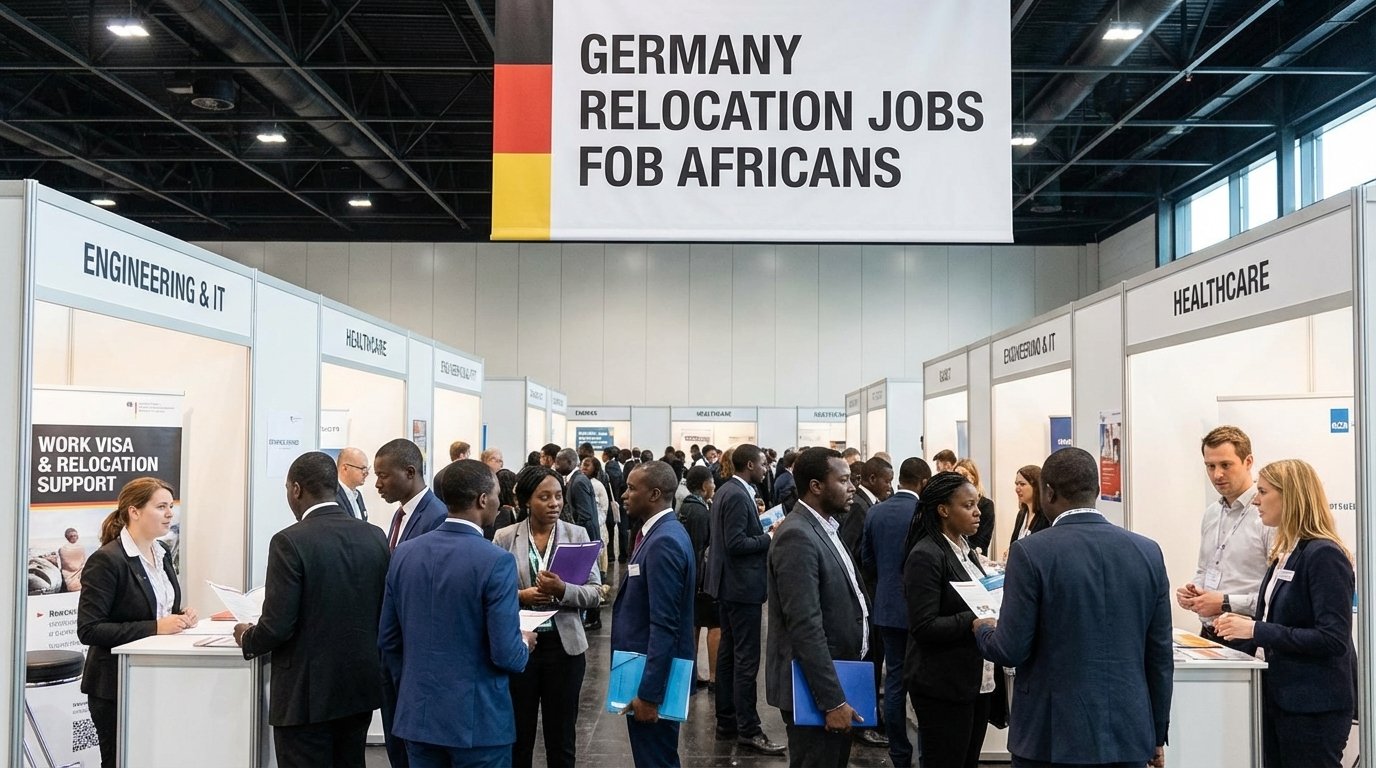
GERMANY RELOCATION JOBS
Germany Relocation Jobs & €6,000 Package Guide
“We need you. The German economy, the Austrian economy, the Swiss economy. We need you so badly. We need every year 450,000 skilled young workers from all over the world.” These aren’t the words of a desperate recruiter—they’re from a German government official speaking in Kenya, practically begging for workers.
Here’s the shocking reality: Germany launched the Opportunity Card visa wanting 30,000 skilled workers per year. They’ve only gotten 11,497 applications total since 2023. Meanwhile, companies like Zalando are throwing €6,000 relocation packages at anyone qualified, covering flights, visas, and one month’s accommodation for entire families. The opportunity gap has never been wider.
This guide reveals exactly how a Kenyan designer landed a €6,000 relocation package through LinkedIn, which companies are actively relocating African workers right now, and how you can use Germany’s new Opportunity Card to move without even having a job offer first.
The LinkedIn Strategy That Got a Kenyan Designer €6,000 to Relocate
Theory Clan didn’t just dream about relocating to Germany—she made it happen through strategic LinkedIn engagement. Zalando approached her directly after spotting her optimized profile, offering a complete relocation package for her entire family from Kenya to Berlin.
The package was comprehensive: €6,000 covering visas for the whole family (husband and two kids), flight tickets for everyone, and one month’s accommodation in Berlin’s CBD. But here’s what made the difference—Zalando also provided a relocation expert who handled everything from address registration to finding kindergarten spots for the children.
Her LinkedIn strategy was deceptively simple but devastatingly effective. Every morning, she’d check her email first for application responses, then immediately open LinkedIn. She connected with people in her field, commented on posts for visibility, and most crucially—connected directly with recruiters at German companies. When Zalando posted opportunities, she was among the first to know and apply. The recruiter noticed her consistent engagement and reached out directly.
Key Takeaway Box: 💰 What €6,000 Relocation Actually Covers:
- ✅ Work visa fees for primary applicant
- ✅ Family reunion visas for spouse and children
- ✅ Flight tickets for entire family
- ✅ 1 month furnished accommodation
- ✅ Relocation expert assistance
- ✅ Address registration support
- ✅ School/kindergarten placement help
- ✅ Apartment hunting assistance
Companies Actually Relocating African Workers Right Now
Tech Companies with Proven Track Records
The tech sector leads Germany’s relocation revolution, with three companies standing out for their proven African recruitment. Zalando, the fashion e-commerce giant, actively recruits designers and developers from Kenya, Nigeria, and South Africa, offering packages starting at €50,000 annually. HelloFresh, the meal-kit delivery service, has relocated multiple African professionals, particularly in logistics and tech roles at €45,000-65,000. Babbel, the language learning platform, specifically targets multilingual African talent for content and engineering positions.
But the real game-changer is the African Skills 4 Germany (AS4G) program, operating in 11 African countries including Nigeria, Kenya, Ghana, South Africa, Tanzania, Egypt, Morocco, Tunisia, Algeria, Angola, and Côte d’Ivoire. This German government-backed initiative connects skilled Africans directly with German employers desperate for talent. They’re not just recruiting—they’re actively preparing candidates with language training and cultural orientation.
According to recent data, over 1,000 German companies didn’t require German language skills for most positions in the past year, with 280+ offering full visa and relocation support. Companies like IBM, SAP, Amazon AWS, and Microsoft’s German offices are competing aggressively for African tech talent, with starting salaries ranging from €55,000 to €85,000.
Beyond Tech: Healthcare, Construction, Hospitality
The opportunities extend far beyond Silicon Valley wannabes. Bluekazi Group, bridging Africa and Germany, reports massive demand for healthcare workers, with monthly net salaries of €1,600-2,200 for nurses and significantly higher for specialized medical professionals. They’re placing workers from Kenya, Uganda, Zambia, Rwanda, and Zimbabwe into guaranteed positions.
Germany’s recent agreement with Kenya to bring 250,000 workers marks a seismic shift. Five Kenyan bus drivers have already arrived in Flensburg as part of the pilot program, with doctors, nurses, and teachers following. The deal streamlines visa processes and guarantees workers’ rights protection.
Construction companies face acute shortages, actively recruiting African engineers and skilled tradespeople. German manufacturing giants like Siemens, Bosch, and Continental offer relocation packages for engineers, with salaries starting at €48,000 for junior positions and reaching €75,000+ for experienced professionals. Even hospitality struggles to fill positions—hotels and restaurants sponsor visas for chefs, hotel managers, and service staff at €30,000-45,000 annually.
Key Takeaway Box: 🏢 Top 10 Companies Actively Relocating + Contacts:
- Zalando – Tech/Design – careers.zalando.com
- HelloFresh – Tech/Logistics – careers.hellofresh.com
- SAP – Enterprise Software – jobs.sap.com
- Delivery Hero – Tech/Operations – careers.deliveryhero.com
- N26 Bank – Fintech – n26.com/careers
- Siemens – Engineering – jobs.siemens.com
- BMW Group – Engineering/IT – bmwgroup.jobs
- Allianz – Insurance/Tech – careers.allianz.com
- Deutsche Telekom – Telecom/IT – telekom.com/careers
- TÜV Rheinland – Technical Services – tuv.com/careers
The Opportunity Card: Your €75 Visa to a €50,000 Job
Two Routes to Germany (No Job Needed!)
Germany’s Opportunity Card (Chancenkarte) revolutionizes immigration by letting you enter Germany without a job offer. If your university degree appears in the Anabin database—Germany’s official recognition system—you qualify automatically. No points needed, no complications. Just prove you have €13,092 for living expenses and basic German (A1) or English (B2), and you’re eligible for a one-year job-seeking visa.
Don’t have Anabin recognition? The points system offers another route. You need just 6 points from criteria including: professional experience (up to 3 points for 5+ years), age (2 points if under 35), language skills (up to 3 points for German), previous Germany stays (1 point), or having a spouse who also qualifies (1 point). With only 11,497 cards issued against a 30,000 annual target, approval rates remain high.
The system deliberately favors younger applicants—if you’re under 35 with 3-5 years’ experience and basic English, you’re already at 5 points. Add any German language skills or a previous study visit to Germany, and you’ve crossed the threshold. IT specialists get special treatment: no formal qualifications required if you can prove your skills through portfolios or work experience.
Real Costs and Timeline
Forget the horror stories about expensive visa processes. The Opportunity Card costs just €75, processing takes 4-8 weeks, and you can start working part-time immediately upon arrival. The main financial requirement—€13,092 in a blocked account—sounds daunting, but here’s the loophole: secure a part-time job contract (20 hours/week) before applying, and that replaces the blocked account requirement entirely.
Once in Germany, you can work up to 20 hours weekly while job hunting, easily earning €1,000+ monthly to cover expenses. Trial employment for two weeks with any employer is unlimited—essentially paid interviews. When you land a full-time position, your Opportunity Card converts automatically to a work residence permit without leaving Germany. No visa runs, no additional fees, just seamless transition to permanent employment.
African applicants from countries like Kenya, Nigeria, and South Africa report faster processing times than average, particularly when applying through German consulates that have partnership agreements. The entire process from application to landing in Frankfurt typically takes 2-3 months, compared to 6-12 months for traditional work visas.
Key Takeaway Box: 📊 Opportunity Card Points Calculator:
- Age under 35: 2 points
- Professional experience 3-5 years: 2 points
- Professional experience 5+ years: 3 points
- German A1: 1 point | A2: 2 points | B1+: 3 points
- English B2: Meets basic requirement (0 points)
- Previous Germany stay (6+ months): 1 point
- Spouse qualifies: 1 point
- Qualification partly recognized: 4 points
- Shortage occupation: 1 point
- TARGET: 6 points minimum
Work-Life Balance Benefits That Make Germany Irresistible
After 2 Years in Germany, You Can…
Germany’s work culture shock starts after your second year. Suddenly, you’re eligible for a three-month sabbatical with your job guaranteed upon return. Want to backpack through Europe? Start that business idea? Simply need a break? Your employer legally cannot refuse or replace you. This isn’t vacation time—it’s additional to your standard 25-30 days annual leave.
The four-day work week isn’t a Silicon Valley pipe dream here—it’s contractual reality. After two years, you can formally request reduced hours, choosing to work Monday through Thursday only. Your salary adjusts proportionally, but benefits remain intact. One African software developer in Berlin now works four days at 80% salary but maintains full health insurance, pension contributions, and even kept her gym membership subsidy.
Maternity and paternity benefits redefine family support. Mothers receive 14 months paid leave at 67% salary (up to €1,800 monthly), while fathers get two months. Compare that to Nigeria’s three months at varying compensation or Kenya’s three months fully paid—Germany’s extended support allows proper bonding without financial panic. Parents can even split the 14 months between them, with some couples alternating to maintain career progression.
Immediate Benefits from Day One
The strict 9-to-5 culture isn’t myth—it’s legally protected reality. Your boss calling on weekends? Illegal. Emails after 6 PM? Culturally forbidden. Working overtime without compensation? You can sue. Germans compartmentalize work and life with religious fervor, and as an immigrant, you’re immediately protected by these same labor laws.
Family reunification happens instantly for skilled workers. Your spouse receives an unrestricted work permit—no job offer needed, any field allowed. Children access Germany’s world-class education system free from kindergarten through university. Healthcare covers the entire family under one insurance plan, typically costing 7-8% of your gross salary with your employer paying another 7-8%.
The financial benefits compound quickly. No school fees saves €10,000+ annually per child compared to international schools in African capitals. Free university education worth €200,000+ over four years. Subsidized public transport (€49 monthly for unlimited regional travel), childcare support (€250 monthly per child until 18), and even culture passes providing free museum and theater access.
Key Takeaway Box: 🏖️ Germany vs Other Countries Benefits:
- Germany: 25-30 days vacation + 3-month sabbatical option + unlimited sick days
- UK: 20 days vacation + no sabbatical right + limited sick pay
- USA: 10 days average + no sabbatical + unpaid sick leave common
- Canada: 10-15 days vacation + no sabbatical + provincial sick leave varies
- Germany: 14 months parental leave at 67% pay
- UK: 9 months at varying pay (first 6 weeks 90%)
- USA: 0 days federally mandated
- Canada: 12-18 months at 55% pay
Document Preparation Hacks from Successful African Relocators
The Anabin Secret Nobody Tells You
The Anabin database holds your golden ticket, but most African applicants don’t know how to use it. Visit anabin.kmk.org, select your country, then search your university. If it shows “H+” status, you’re automatically recognized. But here’s the hack: even “H+/-” (partially recognized) gives you 4 points toward the Opportunity Card. Nigerian universities like University of Lagos, Ahmadu Bello, and Covenant University all have H+ status. Kenya’s University of Nairobi, Kenyatta University, and Strathmore are recognized. South Africa has the most with virtually all major universities approved.
Document translation requires specific attention. Birth certificates must be certified first, then translated—not the reverse. For Kenyans, this means visiting Huduma Center’s Foreign Affairs booth (Tuesdays and Wednesdays, afternoons only), leaving documents for verification, then collecting from your birth certificate’s original issuing office. Nigerians need the Nigeria Police Character Certificate (2-3 weeks through CID), while South Africans require SAPS clearance (6-8 weeks). All documents need certified German translations from sworn translators—budget €30-50 per page.
The education qualification trap catches many: your transcripts matter more than your certificate. German employers want to see specific courses, grades, and credit hours. Get your university to issue detailed transcripts with course descriptions in English. If your university uses the British system (First Class, Second Class Upper), include a grading scale explanation. One Ghanaian engineer’s application was delayed three months because German authorities couldn’t interpret “Second Class Upper Division” until he provided a conversion chart.
Salary Negotiation Strategy That Works
Never reveal your African salary—it’s irrelevant and undermines your position. When recruiters ask for salary expectations, flip the script: “What’s the budget allocated for this role?” Germans respect directness, and this question is expected. They’ll typically respond with a range like “€60,000 to €70,000,” then you position yourself at 80-90% of the maximum.
Research shows German salaries cluster predictably: junior roles €35,000-45,000, mid-level €45,000-65,000, senior €65,000-85,000, and management €75,000-100,000+. Use Glassdoor.de, Kununu.com, and Gehaltsvergleich.com for specific role research. Factor in location—Munich and Frankfurt pay 10-15% above Berlin, but cost of living is 20-30% higher.
The range strategy protects you from underselling. Say “Based on my research and experience, I’m targeting €65,000 to €75,000, depending on the complete benefits package.” This shows you’ve done homework, understand German compensation, and consider total compensation beyond base salary. Never accept the first offer—Germans expect negotiation and build buffers into initial proposals.
Key Takeaway Box: 📄 Complete Document Checklist by Country:
Nigeria:
- ✅ Police Character Certificate (CID – 3 weeks)
- ✅ NYSC discharge certificate (if applicable)
- ✅ Transcripts with course descriptions
- ✅ WAEC/NECO results (often accepted for English proof)
Kenya:
- ✅ Certificate of Good Conduct (DCI – 2-3 weeks)
- ✅ Foreign Affairs verification (Huduma Center)
- ✅ HELB clearance certificate
- ✅ KCSE certificate (English proficiency)
South Africa:
- ✅ Police Clearance (SAPS – 6-8 weeks)
- ✅ SAQA evaluation (recommended)
- ✅ Matric certificate with results
- ✅ Unabridged birth certificate
Ghana:
- ✅ Police clearance certificate
- ✅ WASSCE results
- ✅ National Service certificate
- ✅ University grading scale explanation
Your Move Is Overdue—Germany’s Door Won’t Stay Open Forever
Germany needs 450,000 skilled workers annually but they’re nowhere close. The Opportunity Card aimed for 30,000 applications yearly—they’ve managed just 11,497 total. German officials are literally traveling to Africa, begging for workers. This desperation creates your opportunity, but political winds change quickly.
Your choice is binary: apply for the Opportunity Card now (no job needed, just €75 and proof of funds) or target companies directly through the African Skills 4 Germany program. Both paths lead to the same destination—a German work permit, EU residency rights, and salaries that transform your family’s trajectory. The Kenyan designer who inspired this article made her choice through LinkedIn. She’s now in Berlin with her family, earning five times her Nairobi salary.
Update your LinkedIn profile tonight. Use “Open to Work” settings targeting Germany. Connect with five German recruiters weekly. Apply to three German companies daily. The math is simple: Germany needs 450,000 workers, only 11,497 have applied for the Opportunity Card, and companies are offering €6,000 to relocate. The question isn’t whether you’ll get an opportunity—it’s whether you’ll take it before someone else does.