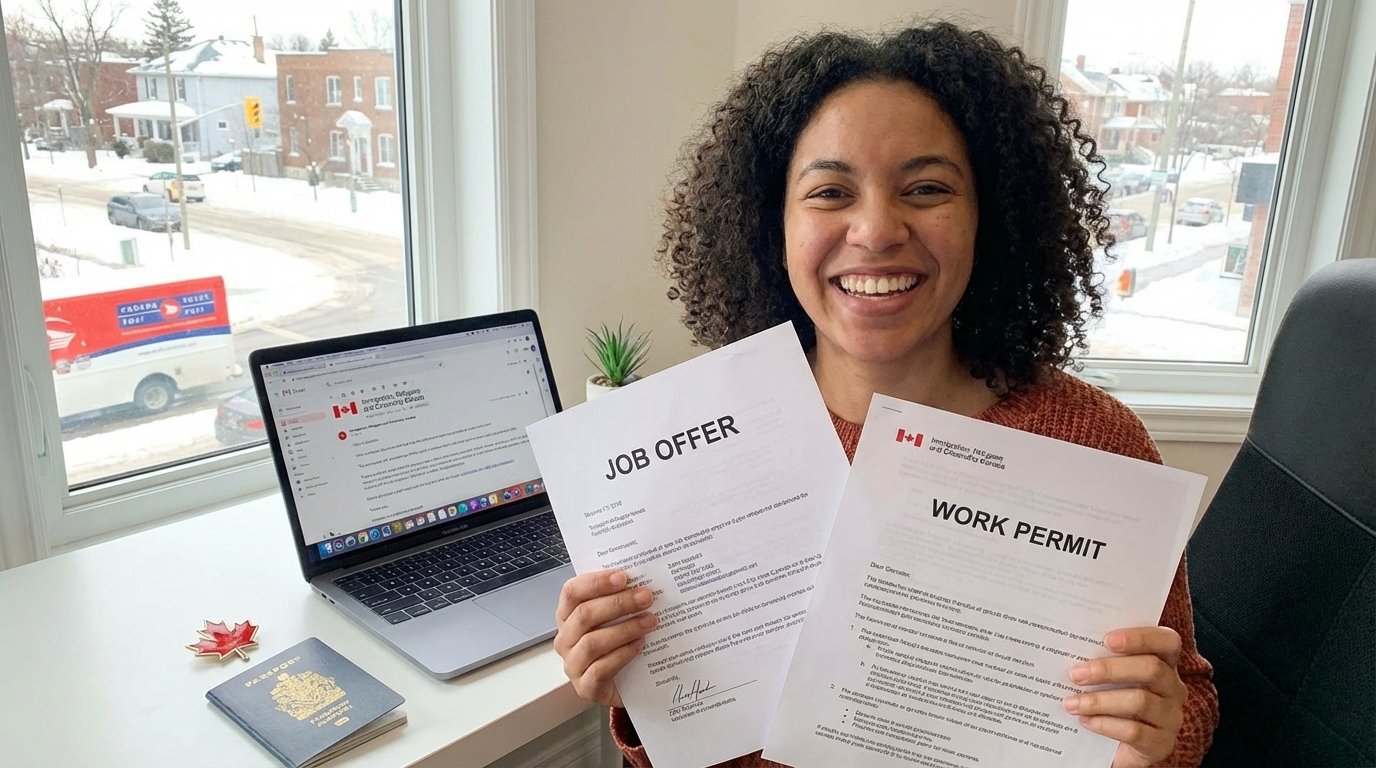
Canada Job Offer with Work Permit 2026: Complete Guide to LMIA + 4 Verified Websites (3-Year PR Pathway)
You’ve watched Clara’s video about “organizations with permission from the Canadian government” to bring foreign workers. You’ve heard about LMIA, sponsored visas, and the 3-year permanent residency timeline. But here’s what nobody’s telling you: every single one of those terms means something specific, and mixing them up is why 90% of applications go nowhere.
LMIA isn’t an organization—it’s a document your employer needs before sponsoring your work permit. Job Bank isn’t just another job website—it’s literally where Canadian employers must post jobs if they want government approval to hire you. And that 3-year PR timeline Clara mentioned? It’s real, but only if you understand the Canadian Experience Class pathway.
By the end of this guide, you’ll know exactly how to use the four job websites Clara showed you (Job Bank, Work Police, Canada Job Expo, Indeed Canada). You’ll understand what LMIA actually means and why it matters more than the job title. And you’ll have the month-by-month roadmap from work permit arrival to permanent residency—the same path that’s bringing 33,000 work permit holders to PR status in 2026-2027.
Understanding Canada Job Offers with Work Permits
Let’s decode what Clara called “sponsored visa” because the terminology matters when you’re filling out applications.
What is a sponsored work permit?
When a Canadian employer “sponsors” you, they’re saying two things to Immigration, Refugees and Citizenship Canada (IRCC): First, they have a legitimate job for you. Second, they’ll support your work permit application by providing documentation that proves the job is real and you’re qualified.
But here’s where it gets specific—and this is what trips up most African applicants.
The LMIA: Your Employer’s Permission Slip
LMIA stands for Labour Market Impact Assessment. According to official Canadian immigration guidelines, it’s a document from Employment and Social Development Canada (ESDC) proving that no Canadian citizen or permanent resident can fill a specific job position.
Here’s the critical part: You don’t apply for LMIA. Your employer does.
The process works like this: A Canadian employer wants to hire you. Before they can offer you a work permit-eligible job, they must advertise the position for a minimum of four consecutive weeks. They’re required to post it on Job Bank (the government portal) plus at least two other recruitment platforms. They have to prove they couldn’t find a qualified Canadian. Only then does ESDC issue a positive LMIA.
Once the LMIA is approved, the employer sends you the confirmation letter. You use this letter to apply for your work permit. Without the LMIA (or an LMIA exemption), you can’t get a work permit for most jobs.
2026 LMIA changes you need to know:
Starting January 1, 2026, agriculture sector exemptions have ended. Previously, agricultural employers didn’t need to advertise as extensively. Now, they follow the same rules as everyone else—which actually benefits you because it creates more transparent job postings.
The government has also tightened restrictions on low-wage LMIA positions (jobs paying below the provincial median wage). But here’s the good news: Canada is expanding the International Mobility Program to 170,000 LMIA-exempt spots in 2026, prioritizing faster processing for shortage occupations.
Three Pathways: Choose Your Strategy
1. Temporary Foreign Worker Program (TFWP): Requires LMIA. Processing time ranges from 10 days (expedited for high-wage, short-duration positions) to 12 months for complex cases. This is what most people think of as “getting a Canadian job offer.”
2. International Mobility Program (IMP): LMIA-exempt pathways for specific situations like intra-company transfers, international agreements (CETA, CUSMA), and some occupation-specific exemptions. Faster processing but narrower eligibility.
3. Express Entry with Job Offer: If you already have Canadian work experience and your employer offers permanent employment, this gives you 50-200 bonus points in the Express Entry pool, massively improving your PR chances.
Key Takeaway: LMIA vs LMIA-Exempt
- LMIA-required (TFWP): Slower (2-12 months), broader job eligibility, most common for first-time foreign workers
- LMIA-exempt (IMP): Faster (weeks to 2 months), specific eligibility criteria, 170,000 spots in 2026
- Your strategy: Apply to both types, but understand LMIA-required jobs are more accessible for most African applicants
- Processing reality: LMIA approval can take 2-4 months, then 2-4 months for work permit—plan 6-8 months total from job offer to Canada arrival
Why Canada’s PR Timeline Beats UK’s 10 Years
Clara mentioned this, and it’s worth emphasizing because it’s one of Canada’s biggest advantages for African immigrants.
The UK comparison: In the UK, you typically need to maintain continuous residence for 10 years before qualifying for Indefinite Leave to Remain (ILR) if you’re on a work visa. Even the faster skilled worker route requires 5 years minimum.
The Canadian reality: Most work permit holders qualify for permanent residency through Canadian Experience Class (CEC) after just 1-3 years of Canadian work experience.
Here’s the math: You arrive in Canada on a work permit. You work for one year in a skilled occupation (NOC TEER 0, 1, 2, or 3). You take language tests (IELTS or CELPIP). You create an Express Entry profile. Within 3-6 months of entering the pool, you receive an Invitation to Apply (ITA) if your score is competitive. Six months later, you’re a permanent resident.
Total timeline: 18 months to 3 years from arrival to PR, depending on your occupation and profile strength.
2026 game-changer: Canada announced a one-time accelerated pathway for 33,000 work permit holders transitioning to PR in 2026-2027. This targets workers who’ve “established strong roots in their communities”—meaning you’ve been working, paying taxes, and contributing to Canadian society.
The program details aren’t fully released yet, but based on the 2021 TR-to-PR pathway (which filled within hours), expect this to require:
- Valid work permit at time of application
- At least 1 year of Canadian work experience
- Language test results
- Potentially specific occupations or regions prioritized
Why this matters: Canada processed 380,000 permanent residents in 2025 and maintaining that target for 2026, with 64% allocated to economic immigration (skilled workers, not family sponsorship). The government wants to convert temporary workers to permanent residents because you’re already contributing to the economy.
Key Takeaway: Canada PR Timeline
- Traditional CEC route: 1 year work experience → Express Entry → 6 months processing = 18-24 months total to PR
- Accelerated 2026 pathway: 33,000 spots for work permit holders (one-time, competitive)
- Benefits while waiting: Free healthcare, legal work status, can bring family once settled
- Comparison advantage: Canada 1-3 years vs UK 5-10 years vs US uncertain/lottery system
Top 4 Job Websites That Actually Work
Forget random Google searches for “Canada jobs with sponsorship.” These four platforms are where legitimate Canadian employers actually post LMIA-eligible positions.
1. Job Bank (jobbank.gc.ca) – The Government Gold Standard
This is the platform Clara emphasized most, and for good reason: Job Bank is operated by the Government of Canada. It’s not a private company, not a recruiter, not an agency—it’s official.
Why Job Bank is non-negotiable:
According to Canada’s LMIA requirements, when a Canadian employer applies for LMIA approval to hire a foreign worker, they must advertise the position on Job Bank for a minimum of four consecutive weeks. This isn’t optional—it’s a legal requirement for the employer to prove they couldn’t find a Canadian for the job.
What this means for you: Every LMIA-eligible job will appear on Job Bank at some point during the employer’s recruitment process. You’re seeing the same listings that ESDC reviews when approving work permits.
How to spot LMIA-supported jobs:
When you search jobs on Job Bank, many listings will indicate if the employer is “advertising to support a Labour Market Impact Assessment.” This is your green light—it means the employer is actively in the LMIA process and needs to hire a foreign worker.
Job Bank also shows employer compliance history. If you click on the employer name, you can see if they’ve successfully hired foreign workers before. This dramatically increases your chances of getting actual visa sponsorship rather than just a polite rejection.
Using Job Bank strategically (Clara’s advice validated):
Clara said “don’t put any province” when searching, and this is smart strategy. Here’s why: LMIA approval rates vary by province and occupation. Ontario might have 1,000 applications for one role, while Saskatchewan has the same role with only 50 applicants. By leaving the location open, you see opportunities you’d otherwise miss.
Job Bank currently lists over 80,000 jobs across all sectors. Use the advanced search to filter by:
- Occupation type (select your NOC code if you know it)
- Hours of work (full-time prioritizes LMIA applications)
- Language of work (English, French, or bilingual)
The advanced search feature: Click where it says “Advanced search” on the homepage. This unlocks filters most people don’t use, like employer size, industry, and crucially, “work permit” indicators that show LMIA involvement.
2. Work Police (workpolis.com)
Work Police (the Canadian spelling is “Workopolis” but the site now operates as Work Police) is Canada’s answer to Indeed—a massive aggregator where employers and recruitment agencies post positions.
What makes Work Police valuable:
They offer a free resume builder with Canadian formatting templates. This matters because Canadian resumes differ significantly from American or British formats. Canadian employers expect chronological order (most recent first), concise bullet points, and they want to see results and accomplishments, not just job duties.
Jobs across all sectors:
As Clara showed in the video, you’ll find positions in:
- Administrative roles (receptionist, accounting, HR)
- Healthcare (registered nurses, healthcare aides, PSWs)
- Warehouse and logistics
- Hospitality (chefs, servers, hotel staff)
- Remote positions (customer service, data entry)
Minimum requirements reality check:
Most entry-level positions require “high school diploma or equivalent.” For African applicants, this means:
- NECO (National Examinations Council) certificate
- WAEC (West African Examinations Council)
- GCSE (General Certificate of Secondary Education)
- Any secondary school leaving certificate
You don’t need a university degree for warehouse, hospitality, or general labor positions. The “or equivalent” phrase is your friend—it means they’ll accept international credentials.
Quick apply feature:
Work Police lets you apply to multiple jobs with one click if you’ve set up your profile properly. Upload your resume once, and when you see a matching position, click “Quick Apply.” The system sends your resume directly to the employer.
Reality check on visa sponsorship mentions:
You’ll notice most Work Police jobs don’t explicitly say “LMIA” or “visa sponsorship.” This is normal. Canadian employers don’t typically advertise it because the LMIA process is expensive (CAD $1,000 application fee) and time-consuming. They only pursue it for candidates they really want to hire.
Apply to jobs that match your skills, even if sponsorship isn’t mentioned. If they like you, they’ll explore LMIA options.
3. Canada Job Expo
This platform is less discussed but specifically targets international professionals. According to their site, they have over 1 million job vacancies across Canada.
What makes Canada Job Expo different:
They explicitly market to “skilled international applicants” rather than treating foreign workers as an afterthought. This means employers posting here are already mentally prepared for the LMIA process—they expect international applications and have budgeted for it.
How to use it:
The site provides step-by-step guidance on starting your job application as a foreign national. They explain Canadian workplace expectations, cultural differences, and what employers are really looking for when they interview international candidates.
Sector focus:
Canada Job Expo particularly emphasizes:
- Technology and IT positions
- Engineering roles
- Healthcare professionals
- Skilled trades (electricians, plumbers, construction)
If you have a degree or professional certification, this is where to focus your applications.
4. Indeed Canada (ca.indeed.com)
Indeed operates globally, but you need the Canadian-specific site: ca.indeed.com. Don’t use indeed.com (US site) or indeed.co.uk—the listings won’t be relevant.
Indeed’s advantages:
- Company reviews: You can see what current and former employees say about working there. This helps you avoid companies with bad reputations for foreign worker treatment.
- Salary information: Many Indeed listings show salary ranges, helping you assess if the position would qualify for LMIA (needs to meet provincial median wage for high-wage positions).
- Application tracking: Indeed lets you save jobs, track which you’ve applied to, and set email alerts for new postings matching your search.
Search strategy:
Use search terms like:
- “[Your occupation] work permit support”
- “[Your occupation] LMIA”
- “[Your occupation] international candidates”
- “[Your occupation] visa sponsorship”
Filter results by:
- Date posted (past 7 days for freshest opportunities)
- Job type (full-time increases LMIA eligibility)
- Location (spread across multiple provinces)
Key Takeaway: Which Website First?
- Start with: Job Bank (government-verified, LMIA indicators)
- Apply broadly: Work Police (volume of entry-level positions)
- If you’re skilled: Canada Job Expo (international applicant focus)
- Track everything: Indeed Canada (application management tools)
- Daily routine: Check all four sites, apply to 3-5 jobs daily, 15-20 per week minimum
How to Actually Get LMIA Job Offers
You’ve found a job posting. You think you’re qualified. Now what? Understanding the LMIA process from the employer’s perspective helps you position yourself as the candidate worth the hassle.
The employer’s LMIA journey:
- Job posting (4+ weeks): They must advertise on Job Bank and at least two other platforms for four consecutive weeks minimum. During this time, they’re documenting every Canadian application they receive and why those candidates weren’t suitable.
- LMIA application: The employer submits their application to ESDC with proof of advertising, business registration documents, evidence they can pay the offered wage, and justification for needing a foreign worker.
- Processing (2-12 months): ESDC reviews the application. Fast-track processing (10 business days) is available for specific categories like high-wage workers earning top 10% of provincial wages, but standard processing takes 2-4 months, and complex cases can take up to 12 months.
- Positive LMIA issued: The employer receives confirmation. This LMIA is valid for 6 months only. They must give it to you quickly so you can apply for your work permit before it expires.
Your role in this process:
You can’t speed up LMIA processing—that’s entirely between the employer and ESDC. What you CAN control:
Be the obviously qualified candidate: Your resume should clearly show you meet every requirement in the job posting. If they want “2 years warehouse experience,” your resume should explicitly say “3 years warehouse experience at [Company Name], managing inventory of 10,000+ units.”
Show long-term commitment: Employers spend CAD $1,000+ on LMIA applications. They don’t want you leaving after six months. In your cover letter, mention your interest in building a career in Canada, potentially mentioning the PR pathway. This signals you’re worth the investment.
Respond immediately: If an employer contacts you, respond within 24 hours. They’re probably interviewing multiple candidates, and Canadian employers value responsiveness as a sign of professionalism.
Understand the timeline: When an employer says “We’ll start the LMIA process,” don’t book your flight. From job offer to LMIA approval to work permit to actually landing in Canada can take 6-12 months realistically. Plan accordingly.
What “LMIA-exempt” actually means:
Some jobs don’t require LMIA through the International Mobility Program. These include:
- Intra-company transfers (you work for a company abroad, they transfer you to Canadian branch)
- International trade agreements (CETA for Europeans, CUSMA for Americans/Mexicans)
- Significant benefit to Canada (distinguished professors, business owners bringing investment)
- Reciprocal employment (Canadians have similar work opportunities in your country)
For most African first-time applicants, LMIA-required is your pathway. The LMIA-exempt routes typically need existing employment relationships or specialized expertise.
Key Takeaway: LMIA Application Timeline
- Employer advertising: 4 weeks minimum
- LMIA processing: 10 days (expedited) to 12 months (complex)
- Your work permit application: 2-4 months after LMIA approval
- Total realistic timeline: 4-8 months from job offer to Canada arrival
- Positive LMIA validity: 6 months (apply for work permit immediately)
The 3-Year PR Pathway Explained
Clara said “3 years at most” for permanent residency, and she’s right for Canadian Experience Class applicants. Here’s your month-by-month roadmap.
Months 1-12: Arrival and Canadian Experience Building
You land in Canada on your work permit. Your first year is about:
- Performing well at work: Your employer might write a reference letter later for your PR application. Strong performance matters.
- Building Canadian credit: Open a bank account, get a secured credit card, pay bills on time. Credit history helps with renting better apartments and eventually buying a home.
- Taking language tests: Book your IELTS or CELPIP exam around month 9-10. Language scores are valid for two years, and you’ll need them for Express Entry. Target CLB 9 or higher in each category (reading, writing, listening, speaking) for maximum points.
- Understanding your NOC code: Every occupation in Canada has a National Occupational Classification code. Find yours on the government NOC website. You’ll need it for Express Entry.
Months 13-18: Express Entry Profile Creation
After 12 months of full-time work in a skilled occupation (NOC TEER 0, 1, 2, or 3), you’re eligible for Canadian Experience Class.
Create your Express Entry profile. You’ll need:
- Language test results
- Educational Credential Assessment (ECA) if you have foreign education
- Proof of Canadian work experience (reference letters, pay stubs, T4 tax forms)
- Police certificates from every country you’ve lived in for 6+ months since age 18
Your profile generates a Comprehensive Ranking System (CRS) score based on age, education, language, work experience, and other factors. According to recent Express Entry draws, CEC candidates typically need 450-480 points to receive an Invitation to Apply (ITA), though this varies by draw.
Having a valid job offer from your current employer (the one who sponsored your work permit) can add 50-200 bonus points to your CRS score, depending on the occupation.
Months 19-24: ITA and PR Application
If your score is high enough, you receive an ITA. You have 60 days to submit your complete PR application with all supporting documents.
IRCC processing for Express Entry typically takes 6 months from complete application to PR approval.
Month 24-30: Landing as Permanent Resident
Once approved, you receive your Confirmation of Permanent Residence (COPR). If you’re already in Canada (which you are, on your work permit), you don’t need to leave and re-enter. You complete a virtual landing or visit an IRCC office to activate your PR status.
Congratulations—you’re now a permanent resident with all the benefits: healthcare, social services, ability to live anywhere in Canada, and eligibility for citizenship after 3 more years.
The 2026 Accelerated Option
Remember those 33,000 accelerated PR spots for 2026-2027? If you arrive in Canada in 2024-2025, you might qualify for this faster pathway instead of waiting for regular Express Entry timelines.
The government hasn’t released full eligibility details yet, but based on the 2021 TR-to-PR program, expect requirements like:
- Current valid work permit
- Working in essential occupations (healthcare, trades, certain service sectors)
- Living in specific regions (possibly prioritizing rural or smaller cities)
- Clean compliance record (no work permit violations)
When this program opens, it will likely fill within hours or days. Have all documents ready in advance: updated resume, reference letters, language scores, police certificates, proof of funds.
Key Takeaway: Month-by-Month PR Roadmap
- Months 1-12: Work, perform well, build Canadian credit, take language tests
- Month 12: Eligible for Canadian Experience Class
- Months 13-18: Create Express Entry profile, wait for ITA
- Months 19-24: Submit PR application, 6-month processing
- Month 24-30: Receive PR status
- Total timeline: 2-3 years from work permit arrival to permanent residency (vs UK’s 5-10 years)
Minimum Requirements That Actually Matter
Let’s cut through the confusion about what you actually need before applying to Canadian jobs.
Educational Requirements:
For most entry-level positions (warehouse, hospitality, general labor, retail), employers require:
- High school diploma or equivalent
This means your NECO, WAEC, GCSE, O-levels, or any secondary school leaving certificate qualifies. You don’t need university degrees for these positions.
For skilled positions (engineering, IT, healthcare professionals), you’ll need:
- Post-secondary education (diploma or degree)
- Educational Credential Assessment (ECA) from a designated organization proving your foreign credentials are equivalent to Canadian standards
World Education Services (WES) is the most commonly used ECA provider. Apply early—assessments can take 6-8 weeks.
Job Offer Legitimacy:
Your Canadian employer must provide:
- Written job offer stating position title, duties, wage, start date, and work location
- Proof of business legitimacy (for LMIA applications, employers submit business registration, tax documents, etc.)
- NOC code indicating the occupation classification
Legal Requirements:
- Clean criminal record: You’ll need police certificates from every country you’ve lived in for 6+ months since age 18
- Medical examination: From an IRCC-approved panel physician in your country
- Proof of funds: Requirements vary, but generally CAD $10,000-$15,000 to support yourself until first paycheck
- Valid passport: Must be valid for the duration of your intended stay
Language Ability:
For English-speaking provinces (most of Canada), you need functional English. No formal test required for work permit application, but employers expect conversational ability for interviews.
For PR applications later, you’ll need language test results (IELTS minimum 6.0 overall, higher scores improve your chances).
For Quebec, French is the primary language. If you’re targeting Quebec specifically, French proficiency is essential.
Sector-Specific Requirements:
- Registered nurses/healthcare professionals: Must obtain provincial license recognition before starting work. Each province has different requirements. Start this process early—it can take 6-12 months.
- Skilled trades (electricians, plumbers, etc.): May need Canadian Red Seal certification or provincial certification depending on the trade and province.
- Teachers: Need provincial teaching certification.
- Drivers (truck drivers, delivery): Need Canadian driver’s license and potentially commercial driving credentials.
The “Experience” Question:
Many jobs say “2-3 years experience required.” Should you apply if you don’t have it?
Yes, apply anyway. Canadian employers often list “preferred” requirements but will consider candidates with transferable skills or strong work ethic. If you have 1 year of relevant experience instead of 3, apply and emphasize your quick learning ability and reliability.
Your 7-Day Action Plan
Stop researching and start executing. Here’s your week-by-week game plan.
Day 1: Account Setup
Create free accounts on:
- Job Bank (jobbank.gc.ca)
- Work Police (workpolis.com)
- Indeed Canada (ca.indeed.com)
- Canada Job Expo
Set up job alerts on each platform for your target occupation. You’ll receive daily emails when matching jobs are posted.
Day 2: Canadian Resume Creation
Canadian resumes differ from American or British formats. Use Work Police’s free resume builder to create a Canadian-format resume.
Essential elements:
- Contact information (phone with country code, professional email)
- Professional summary (2-3 sentences about your skills and goals)
- Work experience in reverse chronological order (most recent first)
- Bullet points focusing on results and accomplishments, not just duties
- Education section (specify that WAEC/NECO is equivalent to high school diploma)
- Skills section (technical skills, software proficiency, languages spoken)
Keep it to 2 pages maximum. Canadian employers don’t want lengthy CVs.
Day 3-5: Application Blitz
This is where most people fail. You apply to 5 jobs, hear nothing, and give up.
Minimum application volume: 15-20 jobs per week.
This isn’t desperation—it’s strategy. The math works like this:
- Apply to 20 jobs
- Get 2-3 responses (10-15% response rate is normal)
- 1-2 interviews
- 0-1 offer
If you only apply to 5 jobs weekly, you’re looking at months before getting a single offer.
Clara’s advice on provinces: Don’t limit yourself to Toronto or Vancouver. Apply to jobs in:
- Alberta (Calgary, Edmonton) – higher wages, lower cost of living
- Manitoba (Winnipeg) – Provincial Nominee Program advantages
- Saskatchewan (Regina, Saskatoon) – easier LMIA approvals
- Atlantic provinces (Nova Scotia, New Brunswick) – Atlantic Immigration Program benefits
Day 6: NOC Code Research
Every occupation in Canada has a National Occupational Classification code. Search yours on the government NOC website.
Understanding your NOC code helps you:
- Apply to correctly categorized jobs
- Know if your occupation qualifies for Express Entry
- Determine required education/experience levels
- Identify shortage occupations in different provinces
Day 7: Follow-Up and Organization
Create a spreadsheet tracking:
- Company name
- Job title
- Date applied
- Follow-up date (5-7 days after application)
- Status (applied, interviewed, rejected, offered)
Send follow-up emails to employers you haven’t heard from after 5-7 days:
Subject: Following Up on [Position Title] Application
Dear Hiring Manager,
I submitted my application for the [Position Title] role on [Date]. I remain very interested in this opportunity and believe my [relevant experience] makes me a strong candidate.
I am available for an interview at your earliest convenience and am prepared to relocate to Canada once a work permit is secured.
Thank you for considering my application.
[Your Name]
[Email]
[Phone with country code]
What Happens After You Get an Offer:
- Employer applies for LMIA (if required): 2-4 months processing
- Employer sends you LMIA confirmation: Do this immediately
- You apply for work permit: Submit online through IRCC with LMIA letter, job offer, police certificates, medical exam results
- Work permit processing: 2-4 months
- Receive work permit: Book flight to Canada
- Start work: Begin your 3-year PR timeline
Key Takeaway: Application Success Volume
- Minimum applications: 15-20 per week for 4-8 weeks
- Expected response rate: 10-15% (2-3 responses per 20 applications)
- Time to first offer: 6-12 weeks of consistent applications
- LMIA + work permit timeline: 4-8 months after offer
- Total timeline: 6-12 months from first application to Canada arrival
Common Mistakes Killing Your Applications
You’re doing everything right—applying consistently, tailoring your resume—but still getting rejections or silence. Here are the landmines most African applicants hit.
Mistake 1: Only applying to jobs that say “LMIA” or “sponsorship”
Most legitimate Canadian employers don’t advertise LMIA in job postings. They’re testing the local market first (as legally required), and only pursue LMIA if they find a foreign candidate they really want.
Apply to jobs based on whether you’re qualified, not whether sponsorship is mentioned.
Mistake 2: Limiting yourself to Toronto or Vancouver
These cities are saturated with applicants, both local and international. LMIA approval rates are lower because employers can usually find Canadians for the job.
Smaller cities have desperate labor shortages. A warehouse in Winnipeg might have 50 applicants for 100 openings. The same role in Toronto has 500 applicants for 10 openings.
Spread your applications across provinces strategically.
Mistake 3: Generic “Dear Sir/Madam” applications
Canadian employers use Applicant Tracking Systems (ATS) that scan for keywords matching the job posting. If the posting says “inventory management experience” and your resume says “stock control experience,” the ATS might reject you despite it being the same thing.
Use exact phrases from the job posting in your resume and cover letter.
Mistake 4: Wrong NOC code matching
If you’re a “health care aide” applying to “personal support worker” jobs, the NOC codes might differ even though the work is similar. Research NOC codes for similar job titles and apply to all relevant variations.
Mistake 5: Ignoring the employer’s perspective
Employers spend CAD $1,000+ on LMIA applications and wait months for approval. They want confidence you’ll stay long-term.
In your cover letter, mention:
- Your interest in Canadian permanent residency
- Willingness to commit to a multi-year employment contract
- Understanding that the process takes time and you’re patient
This signals you’re worth the LMIA investment.
Mistake 6: Weak references or no references
Canadian employers almost always check references. List 2-3 professional references (supervisors, managers, HR contacts) with:
- Full name and job title
- Company name
- Email and phone number
- Note about their relationship to you (e.g., “Former supervisor at [Company]”)
Give your references a heads-up that Canadian employers might call. Ask them to emphasize your reliability, punctuality, and work quality.
Mistake 7: Waiting until you have a perfect application
The longest journey starts with the first step. Your resume doesn’t need to be perfect—it needs to be out there. You’ll learn what works by seeing which applications get responses and adjusting accordingly.
Apply now, improve as you go.
Your Canadian Future Starts Now
Let’s recap what you’ve learned:
Job Bank (jobbank.gc.ca) is government-run and legally required for LMIA applications. Start there.
Work Police, Canada Job Expo, Indeed Canada supplement your search with thousands more positions.
LMIA is the employer’s responsibility, not yours. Your job is to be so qualified they’re willing to spend CAD $1,000 and wait 4 months for government approval to hire you.
The 3-year PR timeline is real: 1 year Canadian work experience makes you eligible for Canadian Experience Class. Another 12-18 months in the Express Entry pool and processing, and you’re a permanent resident. That’s 2-3 years total—the fastest permanent residency pathway in any developed country.
33,000 accelerated PR spots are opening in 2026-2027 for work permit holders already in Canada. If you land a Canadian job in 2024-2025, you might qualify for even faster processing.
Timeline reality check: From your first job application today to arriving in Canada is realistically 6-12 months. LMIA processing takes time. Work permit processing takes time. Plan accordingly. Don’t quit your current job until you have a work permit approval in hand.
The application volume that works: 15-20 applications per week, spread across provinces, targeting jobs slightly below your skill level (easier to get) and at your skill level. Do this for 4-8 weeks consistently.
What’s stopping you?
The only thing standing between you and a Canadian work permit is consistent action. The 2021 TR-to-PR program filled in hours. The 33,000 accelerated PR spots in 2026 will be competitive. The time to start applying isn’t “when I’m ready”—it’s today.
Open Job Bank right now. Set up your profile. Apply to three jobs before you close this article.
Your Canadian story starts with job application number one. Will you be the person who says “I should have applied two years ago” or the person landing in Toronto with their work permit approved?
About MIG ABROAD: We help Africans navigate legitimate international opportunities without the confusion. No fake guarantees, no “agent fees,” just real information from official government sources and success stories from people who actually made the move. Follow us for weekly updates on work abroad opportunities, visa changes, and PR pathways explained in plain language.