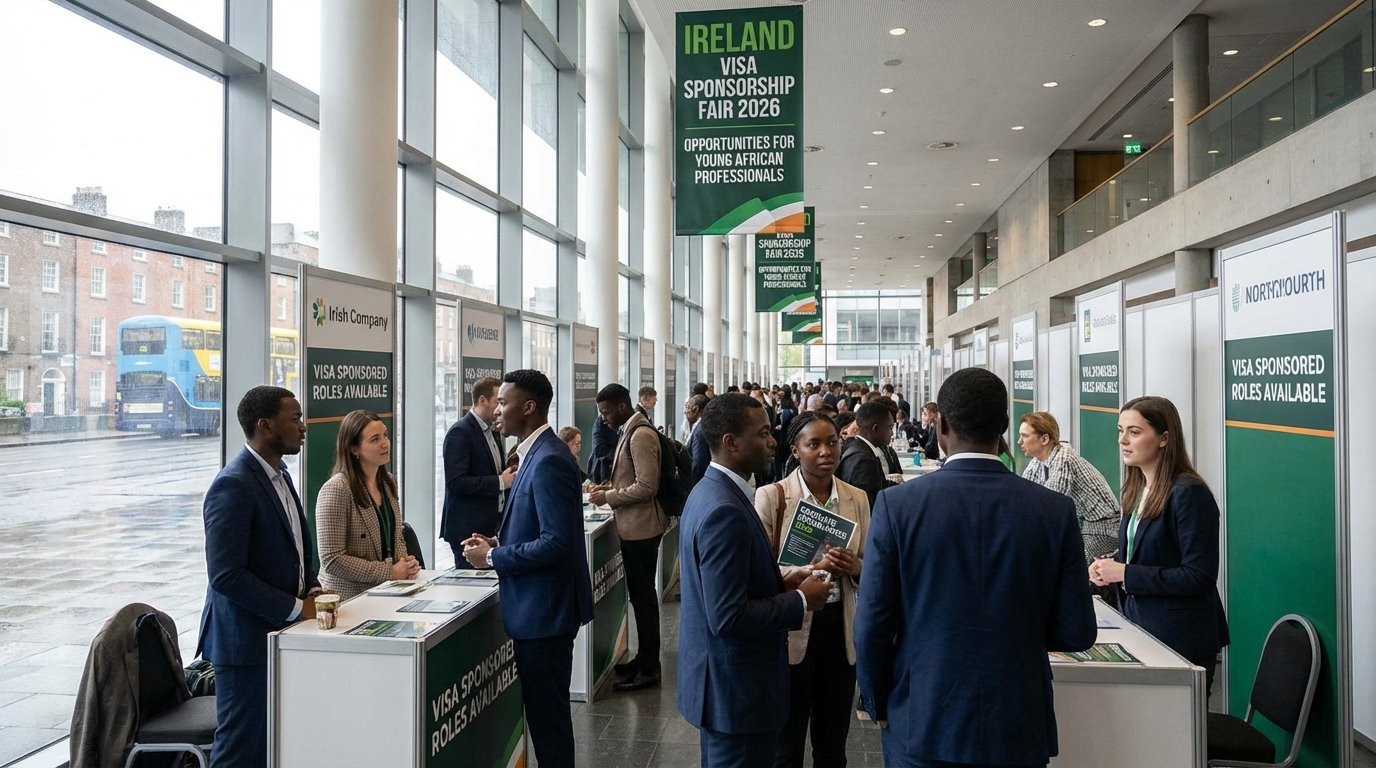
Ireland Visa Sponsorship Jobs 2026
While everyone’s fighting for UK visas that take 5+ years to permanent residency, Ireland quietly offers PR in just 2 years—and tech workers don’t even need sponsorship for their visa. Imagine working at Google Dublin, bringing your family immediately, and holding permanent residency before your colleagues in London even qualify to apply.
Here’s the game-changer most African professionals miss: Ireland’s Critical Skills Employment Permit doesn’t just fast-track your residency—it eliminates the sponsorship requirement entirely for 100+ professions. You just need a job offer at €38,000 or more, and you can apply for the permit yourself. No begging employers for sponsorship letters. No competing with locals for approval.
This guide reveals exactly which companies are actively hiring Africans right now, the real costs involved (spoiler: under €500 out of pocket), and the step-by-step process that gets you from Lagos, Nairobi, or Johannesburg to Dublin’s tech scene in under 3 months.
Why Ireland Is Your Fastest Route to European Permanent Residency
Forget what you’ve heard about the “5-year rule” for European residency. Ireland breaks all the rules with its Critical Skills Employment Permit pathway, offering Stamp 4 permanent residency after just 2 years of work. That’s faster than Canada’s Express Entry, quicker than Australia’s skilled migration, and leaves the UK’s 5-year route in the dust.
The benefits start from day one. Your spouse gets an immediate work permit—no waiting, no restrictions, working in any field they choose. Your children access free primary and secondary education in one of Europe’s best education systems. After 21 months on a Critical Skills permit, you can apply for Stamp 4, which gives you the right to live and work without any employment restrictions.
But here’s where it gets really interesting: After 5 years total (including your 2 years on the Critical Skills permit), you qualify for Irish citizenship. That’s not just any passport—it’s ranked 4th globally for travel freedom, giving you visa-free access to 186 countries plus the right to live and work anywhere in the EU. Compare that to waiting 5 years just for UK permanent residency, then another year for citizenship, with no EU benefits.
Key Takeaway Box: ⏰ Residency Timeline Comparison:
- Ireland: 2 years → PR | 5 years → Citizenship (EU passport)
- UK: 5 years → ILR | 6 years → Citizenship (no EU access)
- Canada: 3-4 years → PR | 6 years → Citizenship
- Germany: 5 years → PR | 8 years → Citizenship
- USA: 5+ years → Green Card | 10+ years → Citizenship
The Critical Skills List: 100+ Jobs That Don’t Need Sponsorship
Tech Roles Dominating the List
The Critical Skills Occupations List reads like a Silicon Valley job board. Software engineers, data scientists, and cybersecurity specialists don’t just qualify—they’re desperately needed. The minimum salary threshold sits at €38,000 (roughly $41,000), but most tech roles pay significantly higher.
Take IBM Ireland, currently advertising 46 positions. Their senior backend developer role in Dublin starts at €65,000, with no degree requirement—just proven skills. Google Dublin has 115 open positions right now, including software engineers at €70,000-90,000 and technical solutions engineers at €55,000-75,000. Meta’s production engineers earn €75,000-95,000, and they explicitly state “visa sponsorship available.”
What makes this different from other countries? These companies don’t need to prove they couldn’t find an EU citizen for the role. The Critical Skills permit exempts them from the Labour Market Needs Test, meaning your application moves straight to processing. No waiting for job advertisements to expire. No competing with local candidates for government approval.
Healthcare & Engineering Opportunities
Beyond tech, healthcare professionals find doors wide open. Nurses with qualifications recognized by the Nursing and Midwifery Board of Ireland start at €35,000-45,000, but more importantly, they qualify for the 2-year fast track to permanent residency. The Health Service Executive (HSE) actively recruits from Nigeria, Kenya, and South Africa, offering relocation packages worth €3,000-5,000.
Engineers across all specializations—civil, mechanical, electrical, chemical—command salaries from €45,000-70,000. Your African engineering degree needs evaluation through Engineers Ireland, but the process is straightforward and takes 6-8 weeks. Construction companies like John Sisk & Son and Mercury Engineering regularly sponsor African engineers, especially those with experience in large infrastructure projects.
Key Takeaway Box: 💼 Top 10 Critical Skills Jobs for African Applicants:
- Software Developer: €50,000-80,000 (No sponsorship needed)
- Data Scientist: €55,000-85,000 (High demand)
- Registered Nurse: €35,000-45,000 (Fast-track PR)
- Cybersecurity Analyst: €60,000-90,000 (Immediate start)
- Cloud Architect: €70,000-100,000 (Remote options)
- Mechanical Engineer: €45,000-65,000 (Direct qualification)
- Pharmacist: €50,000-70,000 (Recognition pathway available)
- DevOps Engineer: €55,000-75,000 (Startup opportunities)
- Quantity Surveyor: €45,000-60,000 (Construction boom)
- Financial Analyst: €45,000-65,000 (IFSC opportunities)
Companies Actually Sponsoring African Workers Right Now
Tech Giants Leading the Way
The tech sector isn’t just hiring—it’s actively courting African talent. Microsoft alone approved 1,790 visas in 2022, with African workers comprising a significant portion. Their Dublin office focuses on cloud services and AI development, areas where African tech talent has proven particularly strong.
Google Dublin operates as the European headquarters, managing everything from advertising operations to cloud infrastructure. They’re currently hiring for trust and safety managers (€60,000), technical program managers (€75,000), and software engineers (€70,000+). The beauty? These roles fall under Critical Skills, meaning you apply for your permit independently once you have the job offer.
Meta (Facebook) runs its international headquarters from Dublin, employing over 3,000 people. Their current openings include production engineers, investigative analysts, and network engineers. Amazon’s Dublin office, supporting AWS and retail operations, has over 5,000 employees and constantly recruits for cloud architects, solutions architects, and DevOps engineers.
Beyond Tech: Healthcare, Finance, Construction
The HSE actively recruits internationally, particularly from countries with English-language medical training. Nigerian doctors and nurses find their qualifications recognized quickly, often within 3-4 months. Private healthcare groups like Beacon Hospital and Blackrock Clinic offer even higher salaries, with specialized nurses earning €45,000-55,000.
The Big Four accounting firms—PwC, Deloitte, EY, and KPMG—collectively sponsor hundreds of permits annually. PwC Ireland alone has over 3,000 employees and regularly hires African accountants, particularly those with ACCA or CIMA qualifications. Starting salaries for audit associates sit at €35,000-40,000, rising to €70,000+ for managers.
Construction companies face severe labor shortages, making them eager sponsors. John Sisk & Son, Ireland’s largest construction company, actively recruits quantity surveyors, project managers, and civil engineers from Africa. Salaries start at €45,000 for junior roles, reaching €80,000+ for project managers with African mega-project experience.
Key Takeaway Box: 🔗 Direct Application Links & Tips:
- Tech: Apply directly on company career pages, not through agencies
- Healthcare: Register with HSE’s Global Recruitment team
- Finance: Target January and September intake periods
- Construction: Emphasize large-project experience from Africa
- Pro tip: Use Europass CV format—it’s what Irish employers expect
Real Costs Breakdown for African Applicants
What Employers Pay vs What You Pay
Here’s where Ireland shines compared to other destinations. The Critical Skills Employment Permit costs €1,000, but most employers cover this as part of their recruitment investment. Your actual out-of-pocket expenses are surprisingly manageable.
Your visa application costs €60 for single entry or €100 for multiple entry. Biometrics add another €35. Unlike the UK, which demands £1,423 for the visa plus £624 per year for healthcare surcharge, Ireland keeps it simple. Your total pre-departure costs rarely exceed €500, including medical exams (€150) and police clearance (€50-100 depending on your country).
Nigerian citizens particularly benefit from streamlined processing through VFS Global centers in Lagos and Abuja. The visa processing takes 2-3 weeks, compared to 8-12 weeks for UK visas. South Africans process through the Dublin embassy directly, often receiving decisions within 10 working days.
Living Costs and Initial Setup
Your first month requires €2,000-3,000 for survival, but remember—you’re earning from day one. Dublin rental prices mirror other European capitals: €800-1,200 for a room, €1,500-2,000 for a one-bedroom apartment. But here’s the kicker: tech companies often provide temporary accommodation for your first month, giving you time to find permanent housing.
With Critical Skills positions starting at €38,000, your take-home pay after tax is roughly €2,500 monthly. Compare that to senior developer salaries in Lagos (₦500,000/month = €950) or Johannesburg (R40,000/month = €2,000), and the numbers make sense even accounting for higher living costs. Plus, you’re building toward EU permanent residency—an invaluable long-term investment.
Key Takeaway Box: 💰 Complete Cost Checklist (African Applicants):
- ✅ Visa application: €60-100
- ✅ Biometrics: €35
- ✅ Medical exam: €150
- ✅ Police clearance: €50-100
- ✅ Document translations: €100-200
- ✅ Flight ticket: €400-800
- ✅ First month expenses: €2,000-3,000
- Total: €2,795-4,385 (Employer covers €1,000 permit fee)
Step-by-Step Application Process for African Workers
Documents You Need from Africa
The document preparation makes or breaks your timeline. Start with educational credentials—your degree certificate and transcripts need notarization, but here’s good news: WES evaluation isn’t always required. Irish employers often accept African qualifications directly, especially from recognized universities in Nigeria, Kenya, Ghana, and South Africa.
Police clearance requirements vary by country. Nigerians need the Nigeria Police Character Certificate, which takes 2-3 weeks through the Criminal Investigation Department. South Africans require a Police Clearance Certificate from SAPS, typically ready in 6-8 weeks. Kenyans obtain the Certificate of Good Conduct from the Directorate of Criminal Investigations in 2-3 weeks.
English proficiency is simpler than you think. Your WAEC certificate showing English credit often suffices. University graduates from English-speaking African countries rarely need IELTS or TOEFL. Some employers request a brief video interview to confirm communication skills, but formal testing isn’t mandatory for Critical Skills permits.
The Application Timeline
Your journey from application to arrival follows a predictable path. Week 1-2: Apply for jobs using Europass CV format, focusing on companies with stated visa sponsorship. Week 3-4: Attend virtual interviews (most Irish companies interview remotely for international hires). Week 5-6: Receive job offer, negotiate salary, and sign contract.
Once you have the signed contract, the employer or you can apply for the Critical Skills permit through EPOS. Processing takes 4-6 weeks, though trusted partner companies get 1-2 week fast-tracking. With permit approval in hand, apply for your D visa at the Irish embassy or VFS center. This takes another 2-3 weeks.
Upon landing in Dublin, you have 90 days to register for your Irish Residence Permit (IRP) at the Burgh Quay Registration Office. The IRP costs €300 and serves as your residency proof for the next year. After 21 months, start preparing your Stamp 4 application—permanent residency is just around the corner.
Key Takeaway Box: 📅 Month-by-Month Timeline:
- Month 1: Job applications and interviews
- Month 2: Contract signing and permit application
- Month 3: Visa processing and travel preparation
- Month 4: Arrival, IRP registration, start work
- Month 24: Apply for Stamp 4 (permanent residency)
- Month 60: Eligible for Irish citizenship
Your Move to Ireland Starts Now
Ireland isn’t just offering jobs—it’s offering a complete life transformation. Two years to permanent residency, five years to EU citizenship, and immediate opportunities to bring your family make this Europe’s best-kept secret for African professionals. The Critical Skills permit removes traditional barriers, letting you control your immigration destiny.
Your next step is clear: Update your CV to Europass format and start applying to the companies listed above. Focus on roles matching your skills within the Critical Skills Occupations List. Don’t wait for the “perfect” opportunity—Ireland’s labor shortage means multiple chances to upgrade once you’re in the system.
Remember Jackie’s advice from her video about getting that comprehensive e-book with 5,000+ employer contacts? It’s one tool among many, but the real secret is this: Ireland genuinely wants skilled African workers. The system is designed for you to succeed. All you need is the courage to apply.